The landscape of Artificial Intelligence has shifted toward high-efficiency architectures. For software engineers, DevOps teams, and tech startups building AI-powered applications, choosing between the ChatGPT API (OpenAI) and the DeepSeek API is no longer just a benchmark comparison—it is a critical infrastructure financial decision. While OpenAI’s flagship models remain an industry standard for multi-modal tasks, DeepSeek has disrupted traditional market economics by offering comparable performance at a fraction of the operational cost. This deep dive evaluates the technical infrastructure, raw token pricing, and cost-optimization strategies—such as prompt caching —to help you scale production applications efficiently. Core Architecture and API Infrastructure Efficiency To understand why API pricing differs so dramatically between th...
Per-token pricing tells you nothing about whether your product makes money. The number that belongs in a business model is cost per active user per month. It is derived, not quoted, and it exposes problems that a rate card cannot. The model cost_per_user = requests_per_user × (input_tokens × input_price + output_tokens × output_price) Everything else — caching, routing, retries — is a modifier on that expression. Build the base case first, then adjust. A worked example Assume a chat product where an active user sends 40 messages a month, each with 1,500 input tokens (including conversation history) and 400 output tokens. Model Input / 1M Output / 1M Cost per user / month GPT-6 Luna $0.10 $0.50 $0.014 DeepSeek V4.1 Flash $0.30 $1.20 $0.037 Gemini 3.5 Flash-Lite $0.30 $2.50 $0.058 Claude Haiku 4.5 $1.00 $5.00 $0.140 Claude Sonnet 5 $2.00 $10.00 $0.280 GPT-6 Astra $10.00 $50.00 $1.400 The spread is roughly 100x between the cheapest and most expensive option for identical usage...
OpenAI API Pricing 2026: The Definitive Architecture Guide to GPT-6, GPT-5.2, and Prompt Caching Optimization The global artificial intelligence ecosystem of 2026 has entered a challenging phase of consolidation. Enterprise software architects, devops engineering leads, and high-growth technology platforms across top-tier Tier 1 ad markets—including the United States, Canada, the United Kingdom, and France—are no longer captivated by basic model accuracy scores. The central engineering directive of the current fiscal year is clear: achieve production-grade AI Cost Optimization or watch your product margins evaporate . As transactional cloud query volumes scale from thousands to hundreds of millions of daily operations, relying on baseline, one-dimensional vendor price c ards is a critical operational failure. OpenAI’s multi-layered infrastructure matrix—featuring the flagship dense models, advanced token systems, and segmented cached input tokens per million structures—requires in...
Practical ways to cut LLM API spend: prompt caching, model routing, output limits and batching, with the savings each lever delivers.
Onsp
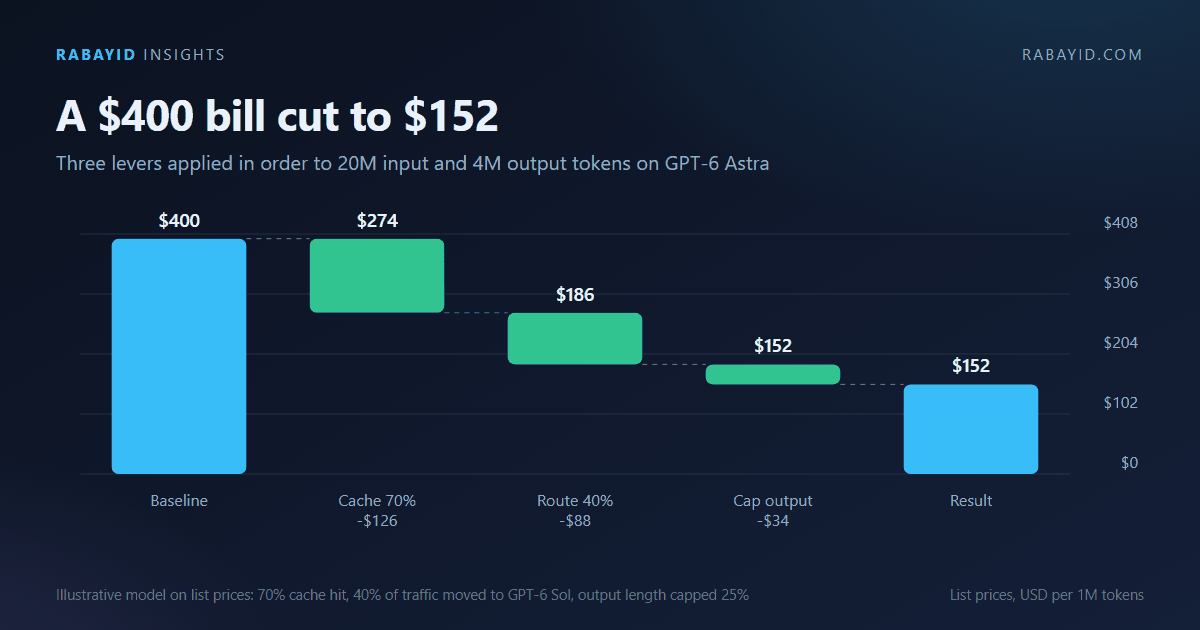
Most cost reductions come from three structural changes, not from prompt micro-tuning. Done in order, they typically remove half to two thirds of a bill without a measurable quality drop.
Step 1: Find where the money actually goes
Log cost per request alongside the feature, endpoint and user tier that produced it. In most applications a small share of requests dominates spend: long-context calls, agent loops that iterate, and retries. Optimising a high-volume cheap endpoint feels productive and moves the total by almost nothing.
Step 2: Route by difficulty
Send every request to the cheapest model that reliably passes evaluation for that task class, and reserve the flagship model for requests that genuinely need it. The spread makes this worthwhile: $0.10 on GPT-6 Luna against $10.00 on Claude Fable 5.1, a 100x difference on input.
A router needs a cheap classifier — a few hundred input tokens on a small model — and a fallback path when the small model's confidence is low. Start with two tiers, not five. Measure accepted-output rate per tier before widening the split.
Step 3: Cache the stable prefix
Move instructions, schemas and reference documents to the front of the prompt and keep them byte-identical across requests. Cache reads run 98% below fresh input on the best model in this dataset, and around 90% on the major providers.
The write premium matters: only cache prefixes that will be reused. A prefix used once costs more with caching than without.
Step 4: Truncate before you pay
Conversation history and retrieved context are usually the largest input line items, and both accumulate silently. Cap history at the last N turns with a rolling summary, and cut retrieved chunks below the relevance threshold rather than always sending the top ten. Halving retrieved context halves that part of the input bill with no change to the prompt logic.
Step 5: Use batch where latency does not matter
Asynchronous work — nightly re-indexing, bulk classification, backfills — belongs on a batch endpoint where one exists. Interactive and batch workloads should not share a code path, because the batch discount is forfeited the moment a request must return quickly.
Step 6: Guard the gains
Savings decay. Set a per-feature monthly budget, alert on week-over-week growth above a threshold, cap max output tokens per endpoint, and review prompt changes like production code. The most common cause of a cost regression is an innocuous prompt edit that doubles input length.
What this looks like in practice
Routing typically contributes the largest single reduction, caching the second, and truncation the third, with batch depending entirely on workload shape. The order matters less than doing all of them and then measuring. Model your expected saving in the calculator first, and compare it to the invoice after a month.
It seems there is something wrong with your internet connection. Please connect to the internet and start browsing again.
AdBlock Detected!
We have detected that you are using adblocking plugin in your browser. The revenue we earn by the advertisements is used to manage this website, we request you to whitelist our website in your adblocking plugin.
Site is Blocked
Sorry! This site is not available in your country.