The landscape of Artificial Intelligence has shifted toward high-efficiency architectures. For software engineers, DevOps teams, and tech startups building AI-powered applications, choosing between the ChatGPT API (OpenAI) and the DeepSeek API is no longer just a benchmark comparison—it is a critical infrastructure financial decision. While OpenAI’s flagship models remain an industry standard for multi-modal tasks, DeepSeek has disrupted traditional market economics by offering comparable performance at a fraction of the operational cost. This deep dive evaluates the technical infrastructure, raw token pricing, and cost-optimization strategies—such as prompt caching —to help you scale production applications efficiently. Core Architecture and API Infrastructure Efficiency To understand why API pricing differs so dramatically between t...
Most cost reductions come from three structural changes, not from prompt micro-tuning. Done in order, they typically remove half to two thirds of a bill without a measurable quality drop. Step 1: Find where the money actually goes Log cost per request alongside the feature, endpoint and user tier that produced it. In most applications a small share of requests dominates spend: long-context calls, agent loops that iterate, and retries. Optimising a high-volume cheap endpoint feels productive and moves the total by almost nothing. Step 2: Route by difficulty Send every request to the cheapest model that reliably passes evaluation for that task class, and reserve the flagship model for requests that genuinely need it. The spread makes this worthwhile: $0.10 on GPT-6 Luna against $10.00 on Claude Fable 5.1, a 100x difference on input. A router needs a cheap classifier — a few hundred input tokens on a small model — and a fallback path when the small model's confidence is low. Start w...
Prompt caching lets a provider reuse work it has already done. When you send a request whose opening tokens exactly match a prefix the provider has processed recently, it skips that portion and bills the reused tokens at a cache-read rate instead of the full input rate. For applications with long system prompts, fixed schemas or repeated document context, this is the largest single lever on API spend. How much cheaper is a cache read The discount differs sharply by provider. The table below shows the cache-read price against the fresh input price for every model in the dataset that publishes one. Model Input Cached input Discount Cache write DeepSeek V4.1 Flash $0.30 $0.0060 98% — Claude Fable 5.1 $10.00 $0.25 97.5% $12.50 DeepSeek V4 Pro $1.32 $0.04 96.7% — GPT-6.1 Sol $2.00 $0.10 95% $2.50 GPT-6 Astra $10.00 $1.00 90% $12.50 GPT-6 Sol $2.00 $0.20 90% $2.50 GPT-6 Luna $0.10 $0.01 90% $0.13 GPT-5.6 Sol $4.00 $0.40 90% $5.00 GPT-5.6 Terra $2.00 $0.20 90% $2.50 GPT-5.6 Luna...
The cheapest LLM API in 2026 depends on your input-to-output ratio. Compare real per-million prices across 28 models for your workload.
Onsp
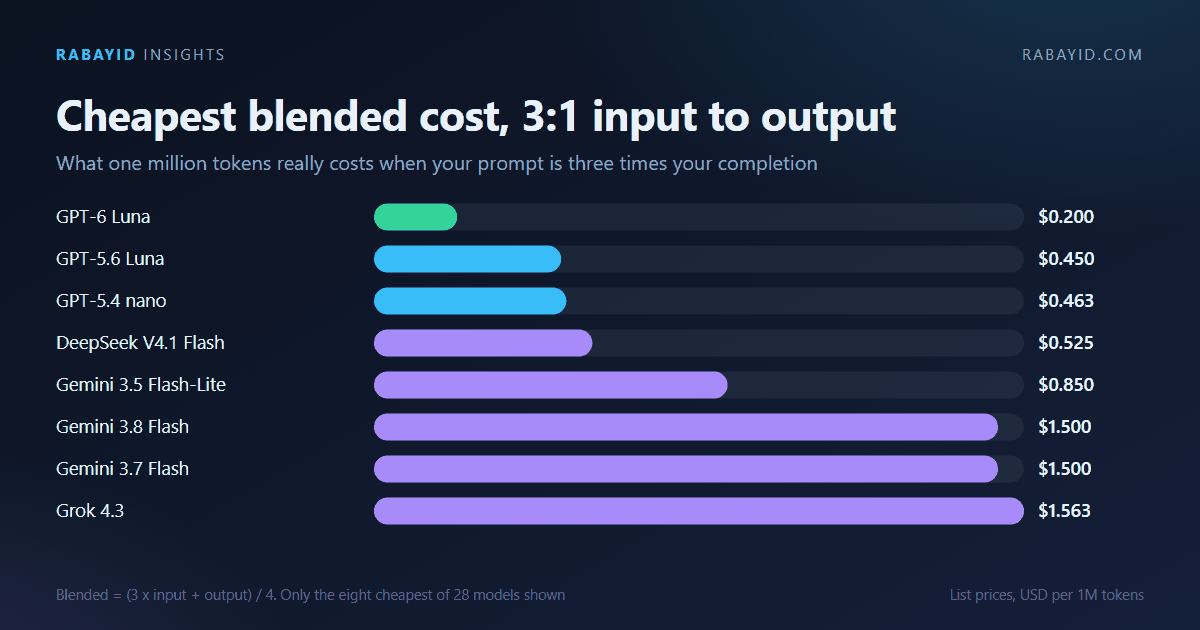
"Cheapest" depends entirely on your input-to-output ratio. A model that wins on input tokens can lose badly once you generate long responses. To make the comparison honest, this ranking uses a blended price assuming three input tokens for every output token, which matches typical chat, extraction and RAG workloads.
Blended cost ranking (3:1 input to output)
Rank
Model
Provider
Blended / 1M
Input
Output
1
GPT-6 Luna
OpenAI
$0.20
$0.10
$0.50
2
GPT-5.6 Luna
OpenAI
$0.45
$0.20
$1.20
3
GPT-5.4 nano
OpenAI
$0.46
$0.20
$1.25
4
DeepSeek V4.1 Flash
DeepSeek
$0.52
$0.30
$1.20
5
Gemini 3.5 Flash-Lite
Google
$0.85
$0.30
$2.50
6
Gemini 3.8 Flash
Google
$1.50
$0.75
$3.75
7
Gemini 3.7 Flash
Google
$1.50
$0.75
$3.75
8
Grok 4.3
xAI
$1.56
$1.25
$2.50
9
GPT-5.4 mini
OpenAI
$1.69
$0.75
$4.50
10
DeepSeek V4 Pro
DeepSeek
$1.98
$1.32
$3.96
Why the winner changes with your workload
At a 3:1 ratio, GPT-6 Luna comes out cheapest at $0.20 blended per million tokens. But ratios differ by product. A summarisation pipeline that reads a long document and returns a short answer might run 20:1. A code generator that reads a short instruction and writes a long file might run 1:5.
Re-rank with your own ratio before trusting any list. The formula is simple: (input_ratio × input_price + output_ratio × output_price) / (input_ratio + output_ratio).
Output-heavy workloads need a different shortlist
If output dominates, the relevant ranking is by output price alone. GPT-6 Luna leads at $0.50 per million output tokens, followed by GPT-5.6 Luna at $1.20 and DeepSeek V4.1 Flash at $1.20.
It is also worth looking at the output-to-input multiple. Grok 4.3 charges 2.0x for output relative to input, the lowest multiple in the dataset, which makes it unusually attractive for generation-heavy work even though its input price is not the lowest.
The cheapest option you are not using
Caching beats model choice in many applications. The deepest cache discount in the dataset is 98% off the input rate on DeepSeek V4.1 Flash. A mid-tier model with a 90% cache hit rate frequently costs less in practice than the cheapest model without caching, because the cheapest model still bills every input token at full price.
Cost per solved task, not per token
A model that costs a third as much but fails one request in five is not cheaper. If a failed request must be retried, the effective price rises by the retry rate. If it must be reviewed by a human, the effective price is dominated by labour cost, not tokens. Benchmark candidates on your own evaluation set and divide total spend by accepted outputs. That number, not the table above, is what belongs in your unit economics.
Run the numbers for your own traffic mix with the free calculator.
It seems there is something wrong with your internet connection. Please connect to the internet and start browsing again.
AdBlock Detected!
We have detected that you are using adblocking plugin in your browser. The revenue we earn by the advertisements is used to manage this website, we request you to whitelist our website in your adblocking plugin.
Site is Blocked
Sorry! This site is not available in your country.