The landscape of Artificial Intelligence has shifted toward high-efficiency architectures. For software engineers, DevOps teams, and tech startups building AI-powered applications, choosing between the ChatGPT API (OpenAI) and the DeepSeek API is no longer just a benchmark comparison—it is a critical infrastructure financial decision. While OpenAI’s flagship models remain an industry standard for multi-modal tasks, DeepSeek has disrupted traditional market economics by offering comparable performance at a fraction of the operational cost. This deep dive evaluates the technical infrastructure, raw token pricing, and cost-optimization strategies—such as prompt caching —to help you scale production applications efficiently. Core Architecture and API Infrastructure Efficiency To understand why API pricing differs so dramatically between t...
Most cost reductions come from three structural changes, not from prompt micro-tuning. Done in order, they typically remove half to two thirds of a bill without a measurable quality drop. Step 1: Find where the money actually goes Log cost per request alongside the feature, endpoint and user tier that produced it. In most applications a small share of requests dominates spend: long-context calls, agent loops that iterate, and retries. Optimising a high-volume cheap endpoint feels productive and moves the total by almost nothing. Step 2: Route by difficulty Send every request to the cheapest model that reliably passes evaluation for that task class, and reserve the flagship model for requests that genuinely need it. The spread makes this worthwhile: $0.10 on GPT-6 Luna against $10.00 on Claude Fable 5.1, a 100x difference on input. A router needs a cheap classifier — a few hundred input tokens on a small model — and a fallback path when the small model's confidence is low. Start w...
Prompt caching lets a provider reuse work it has already done. When you send a request whose opening tokens exactly match a prefix the provider has processed recently, it skips that portion and bills the reused tokens at a cache-read rate instead of the full input rate. For applications with long system prompts, fixed schemas or repeated document context, this is the largest single lever on API spend. How much cheaper is a cache read The discount differs sharply by provider. The table below shows the cache-read price against the fresh input price for every model in the dataset that publishes one. Model Input Cached input Discount Cache write DeepSeek V4.1 Flash $0.30 $0.0060 98% — Claude Fable 5.1 $10.00 $0.25 97.5% $12.50 DeepSeek V4 Pro $1.32 $0.04 96.7% — GPT-6.1 Sol $2.00 $0.10 95% $2.50 GPT-6 Astra $10.00 $1.00 90% $12.50 GPT-6 Sol $2.00 $0.20 90% $2.50 GPT-6 Luna $0.10 $0.01 90% $0.13 GPT-5.6 Sol $4.00 $0.40 90% $5.00 GPT-5.6 Terra $2.00 $0.20 90% $2.50 GPT-5.6 Luna...
"DeepSeek is 17× cheaper than ChatGPT" was true, and it is no longer the useful sentence. The comparison that produced that number was DeepSeek V4 aga
Onsp
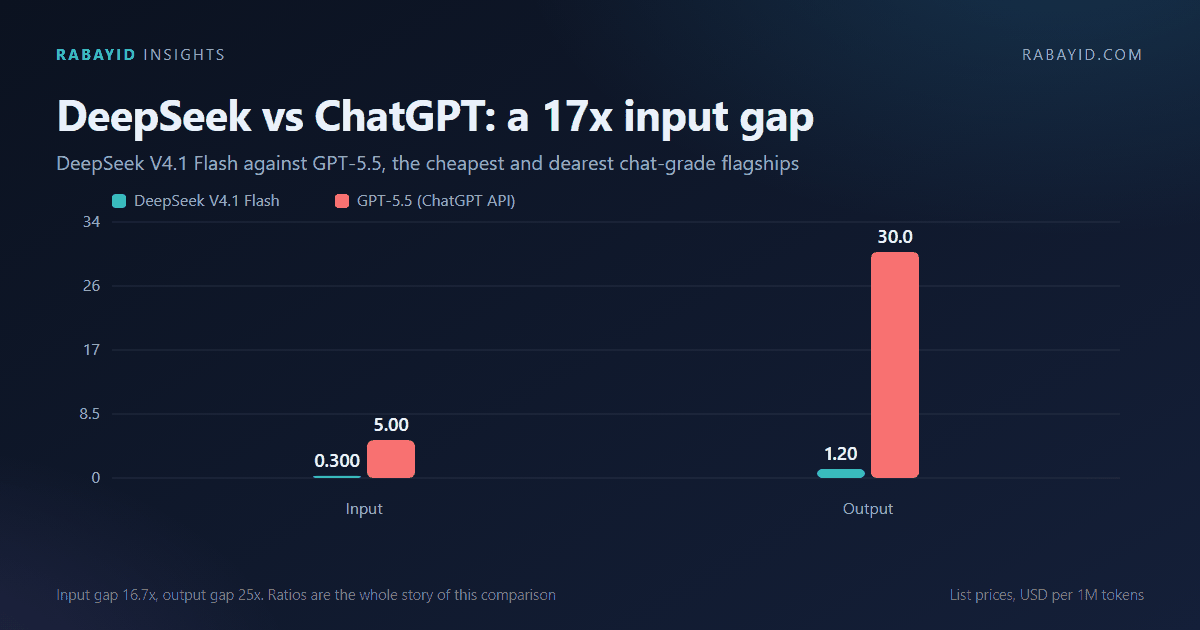
"DeepSeek is 17× cheaper than ChatGPT" was true, and it is no longer the useful sentence. The comparison that produced that number was DeepSeek V4 against GPT-5.5 at $5 input and $30 output. GPT-5.5 is now a legacy model, GPT-6 Luna launched at $0.10 input and $0.50 output, and DeepSeek's own V4.1 Flash sits at $0.30/$1.20. The 17× headline survives only if you compare against a model nobody starting today would choose.
That does not make DeepSeek irrelevant. It makes the decision more interesting: DeepSeek now wins on a different axis — a 1.1 million-token context window at a flat rate, the cheapest cached-input price in the dataset, open weights, and a 50% off-peak discount that no batch API can match for scheduled work. Here is the arithmetic that decides when each advantage actually applies.
The 17× gap was measured against GPT-5.5, not against today's budget tiers.
DeepSeek's current rates
Model
Input
Cached
Write
Output
Context
Batch
Off-peak
DeepSeek V4.1 Flash
$0.30
$0.006
None
$1.20
1.1M
No
−50%
DeepSeek V4 Pro
$1.32
$0.044
None
$3.96
1M
No
−50%
Verified October 2026. Both models are open-weight. Peak rates are shown; the off-peak window bills at half. Neither model offers a Batch API.
Where the 17× came from
V4.1 Flash charges $0.30 input against GPT-5.5's $5.00 — a 16.7× gap — and $1.20 output against $30.00, a 25× gap. Against GPT-6 Sol at $2/$10 the same model is 6.7× and 8.3× cheaper. Against GPT-6 Luna at $0.10/$0.50, DeepSeek is three times more expensive on input and 2.4× on output.
The lesson is not that DeepSeek got worse. It is that the budget tier of every Western provider collapsed in price during 2026, and the "cheapest API" title moved with it. A comparison written in early 2026 is now a misleading one.
The budget tier, ranked by an actual workload
1,000 support conversations: 4,000 input and 600 output tokens each.
Model
Peak cost
Discounted cost
Discount type
GPT-6 Luna
$0.70
$0.70
None
DeepSeek V4.1 Flash
$1.92
$0.96
Off-peak 50%
GPT-5.6 Luna
$1.52
$1.52
None
Gemini 3.5 Flash-Lite
$2.70
$1.35
Batch 50%
DeepSeek V4 Pro
$7.66
$3.83
Off-peak 50%
Claude Haiku 4.5
$7.00
$3.50
Batch 50%
Even at half price, DeepSeek V4.1 Flash does not beat GPT-6 Luna on a chat workload. It beats Flash-Lite, and it beats its own Pro sibling by 4×. If cheap chat is the goal, the answer in this dataset is not DeepSeek.
The off-peak discount is the real product
DeepSeek halves both input and output outside peak hours. For any workload that can be scheduled — nightly enrichment, backfills, report generation, batch evaluation — that is functionally a batch API with a different trigger. The comparison is direct:
Workload
V4.1 Flash peak
V4.1 Flash off-peak
GPT-6 Luna
1,000 support conversations
$1.92
$0.96
$0.70
Nightly job, 10K requests
$54.00
$27.00
$20.00
Cached RAG, 1,000 requests
$2.97
$1.49
$1.46
Off-peak turns a 2.7× deficit into rough parity on RAG and a 1.4× deficit on chat. That is a meaningful difference for a pipeline that runs at 2 a.m. and a meaningless one for a live product.
Caching at 2% is the deepest discount in the market
DeepSeek bills cached input at $0.006 per million — 2% of its $0.30 base rate, and the lowest absolute cached price in this dataset. GPT-6 Luna's cached rate is $0.01, Anthropic's is $0.20, OpenAI's flagship cache is $1.00.
There is no cache-write fee, so caching is free to enable and profitable from the first reuse. For a RAG pipeline that sends the same 45,000-token document block a thousand times, the cached portion costs $0.27 instead of $13.50. The input side of the bill falls by roughly 90%.
The catch is that the base rate is high enough that the total still loses to GPT-6 Luna on the same workload — $2.97 versus $1.46. DeepSeek wins the cache-percentage contest and loses the invoice.
The 1.1M context with no surcharge
This is DeepSeek's strongest remaining structural advantage. V4.1 Flash sells 1.1 million tokens of context at a flat $0.30 input, with no long-context tier. Compare the cost of a single 900,000-token call:
Model
900K input cost
Surcharge
DeepSeek V4.1 Flash
$0.27
None
Claude Sonnet 5
$1.80
None
GPT-6 Sol
$3.60
Doubles above 272K
Gemini 3.8 Flash
$1.35
Doubles above 200K
At that length DeepSeek is 13× cheaper than GPT-6 Sol and 6.7× cheaper than Claude Sonnet 5. For whole-codebase analysis, long transcript processing or single-pass document reasoning, nothing else in this dataset is close on absolute price. The trade-off is model quality: a 900K-token prompt is only useful if the model can still reason across it.
No batch API: what it costs
DeepSeek is the only provider here without a batch tier. The off-peak window is the substitute, but it is not identical: batch guarantees the discount regardless of when you submit, while off-peak requires you to control scheduling. If your pipeline is triggered by user activity rather than a cron job, you pay peak rates — and at peak, DeepSeek V4.1 Flash is 2.7× GPT-6 Luna for the same chat workload.
When to use DeepSeek
Prompts above 300K tokens — the flat 1.1M window is the cheapest way to process a very long document in one pass.
Overnight pipelines — off-peak halves the bill and the work is already asynchronous.
Cache-heavy RAG at scale — $0.006 cached input is unbeatable per token, even if the total loses to Luna on short prompts.
Self-hosting requirements — open weights mean the API is an option, not a dependency.
Not for cheap chat — GPT-6 Luna is cheaper at peak and off-peak alike.
FAQ
Is DeepSeek still the cheapest LLM API?
No. GPT-6 Luna at $0.10 input and $0.50 output undercuts DeepSeek V4.1 Flash at $0.30/$1.20, even after DeepSeek's 50% off-peak discount. DeepSeek remains the cheapest option for very long prompts and for cached input per token.
How does the off-peak discount work?
Requests outside peak hours bill at half the published rate on both input and output. It applies to V4.1 Flash and V4 Pro and requires no enrolment — only that the job can wait for the window.
Does DeepSeek have a batch API?
No. It is the only provider in this dataset without one; the off-peak window is the closest equivalent.
How large is the context window?
1.1 million tokens on V4.1 Flash and 1 million on V4 Pro, both without a long-context surcharge.
It seems there is something wrong with your internet connection. Please connect to the internet and start browsing again.
AdBlock Detected!
We have detected that you are using adblocking plugin in your browser. The revenue we earn by the advertisements is used to manage this website, we request you to whitelist our website in your adblocking plugin.
Site is Blocked
Sorry! This site is not available in your country.