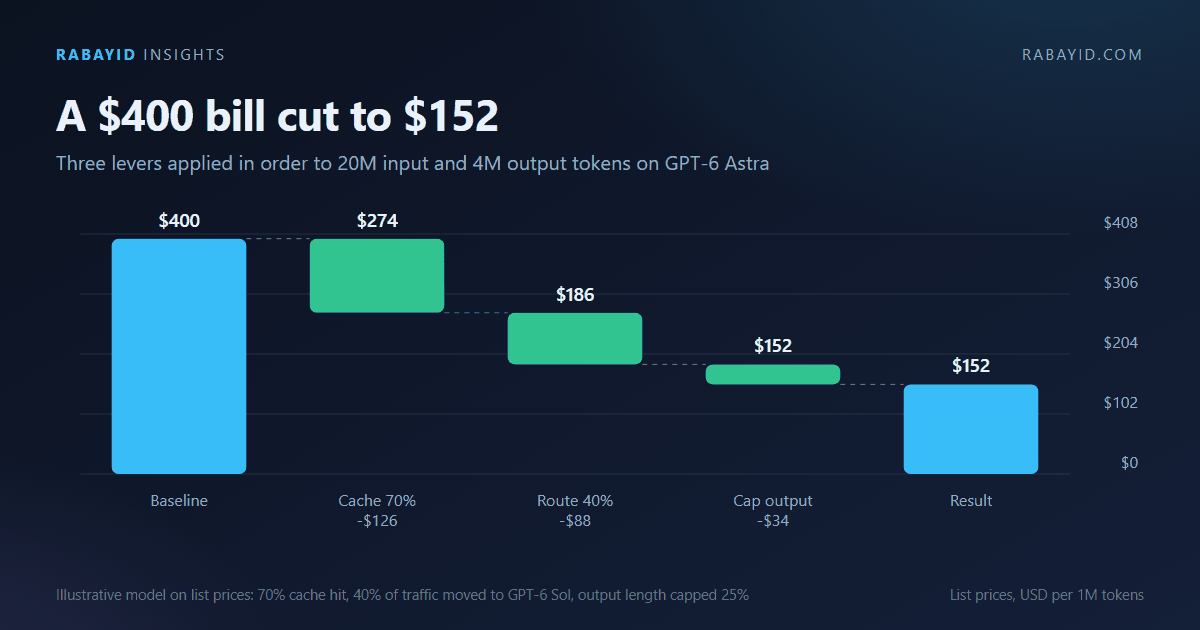
The landscape of Artificial Intelligence has shifted toward high-efficiency architectures. For software engineers, DevOps teams, and tech startups building AI-powered applications, choosing between the ChatGPT API (OpenAI) and the DeepSeek API is no longer just a benchmark comparison—it is a critical infrastructure financial decision. While OpenAI’s flagship models remain an industry standard for multi-modal tasks, DeepSeek has disrupted traditional market economics by offering comparable performance at a fraction of the operational cost. This deep dive evaluates the technical infrastructure, raw token pricing, and cost-optimization strategies—such as prompt caching —to help you scale production applications efficiently. Core Architecture and API Infrastructure Efficiency To understand why API pricing differs so dramatically between t...
Most cost reductions come from three structural changes, not from prompt micro-tuning. Done in order, they typically remove half to two thirds of a bill without a measurable quality drop. Step 1: Find where the money actually goes Log cost per request alongside the feature, endpoint and user tier that produced it. In most applications a small share of requests dominates spend: long-context calls, agent loops that iterate, and retries. Optimising a high-volume cheap endpoint feels productive and moves the total by almost nothing. Step 2: Route by difficulty Send every request to the cheapest model that reliably passes evaluation for that task class, and reserve the flagship model for requests that genuinely need it. The spread makes this worthwhile: $0.10 on GPT-6 Luna against $10.00 on Claude Fable 5.1, a 100x difference on input. A router needs a cheap classifier — a few hundred input tokens on a small model — and a fallback path when the small model's confidence is low. Start w...
Prompt caching lets a provider reuse work it has already done. When you send a request whose opening tokens exactly match a prefix the provider has processed recently, it skips that portion and bills the reused tokens at a cache-read rate instead of the full input rate. For applications with long system prompts, fixed schemas or repeated document context, this is the largest single lever on API spend. How much cheaper is a cache read The discount differs sharply by provider. The table below shows the cache-read price against the fresh input price for every model in the dataset that publishes one. Model Input Cached input Discount Cache write DeepSeek V4.1 Flash $0.30 $0.0060 98% — Claude Fable 5.1 $10.00 $0.25 97.5% $12.50 DeepSeek V4 Pro $1.32 $0.04 96.7% — GPT-6.1 Sol $2.00 $0.10 95% $2.50 GPT-6 Astra $10.00 $1.00 90% $12.50 GPT-6 Sol $2.00 $0.20 90% $2.50 GPT-6 Luna $0.10 $0.01 90% $0.13 GPT-5.6 Sol $4.00 $0.40 90% $5.00 GPT-5.6 Terra $2.00 $0.20 90% $2.50 GPT-5.6 Luna...
GPT-6 Sol and Claude Sonnet 5 have the same price tag: $2.00 per million input tokens, $10.00 per million output.
Onsp
GPT-6 Sol and Claude Sonnet 5 have the same price tag: $2.00 per million input tokens, $10.00 per million output. The same cached rate, $0.20. The same cache-write fee, $2.50. The same batch discount, 50%. On paper they are the same product sold by two companies.
Then a 300,000-token document arrives, and one of them charges twice what the other does. That is not a marketing difference or a rounding artefact — it is a structural difference in how the two providers price long prompts, and it is the only thing that separates two otherwise identical price sheets. This comparison works out exactly where the bills diverge, and which model wins at each length.
Model choice, caching and batching drive most of the savings — but length decides which model is cheaper.
Side by side
Metric
GPT-6 Sol
Claude Sonnet 5
Winner
Input / 1M
$2.00
$2.00
Tie
Output / 1M
$10.00
$10.00
Tie
Cached input / 1M
$0.20
$0.20
Tie
Cache write / 1M
$2.50
$2.50
Tie
Context window
1,050,000
1,000,000
GPT-6 Sol
Long-context tier
Doubles above 272K
None
Claude Sonnet 5
Batch API
Yes, 50%
Yes, 50%
Tie
Three workloads, identical bills
Start with the workloads where the two are indistinguishable. Support chat is 1,000 conversations of 4,000 input and 600 output tokens. Cached RAG is 1,000 requests with a 50,000-token prompt, 45,000 of it cached, and a 1,000-token answer. The nightly job is 10,000 requests of 10,000 input and 2,000 output tokens.
Workload
GPT-6 Sol
Claude Sonnet 5
Difference
Support chat (1K conversations)
$14.00
$14.00
$0.00
Cached RAG (1K requests)
$29.10
$29.10
$0.00
Nightly batch (10K requests)
$200.00
$200.00
$0.00
Identical to the cent, because every input to the calculation is identical. If your prompts stay under 272,000 tokens and you use caching the same way on both, there is no price argument between these models at all. The decision becomes quality, latency and tooling.
The 272,000-token line
OpenAI applies a long-context tier above 272,000 input tokens: GPT-6 Sol moves from $2/$10 to $4/$15. Anthropic does not tier at all — Claude Sonnet 5 bills $2/$10 at 900,000 tokens exactly as it does at 9,000.
Take a document-analysis workload: 200 requests, each with a 250,000-token document and a 1,500-token answer. Then run the same workload at 300,000 tokens.
Prompt length
GPT-6 Sol
Claude Sonnet 5
Gap
250K input (under threshold)
$103.00
$103.00
0%
300K input (over threshold)
$244.50
$123.00
Claude is 50% cheaper
500K input
$407.00
$203.00
Claude is 50% cheaper
900K input
$729.00
$363.00
Claude is 50% cheaper
Nothing changed except the length of the input. A 50,000-token difference — 250K to 300K — turns two identically priced models into a 2× cost difference that persists at every length above the threshold. If your retrieval layer adds "just one more document" and crosses 272K, you have doubled the rate for the entire call, not just for the extra tokens.
This is the single most important number in any GPT-versus-Claude decision, and it is invisible on both pricing pages. The mechanics are covered in long-context cost explained.
The cache rate is where OpenAI's newer model pulls ahead
GPT-6.1 Sol is the same $2/$10 as GPT-6 Sol but bills cached input at $0.10 instead of $0.20 — half. Against Sonnet 5's $0.20, that makes the 6.1 variant the cheapest cached input of the three.
On the cached RAG workload the difference is small but real: $24.61 on GPT-6.1 Sol against $29.10 on either GPT-6 Sol or Sonnet 5, a 15% saving. The reason is that 90% of the input tokens in that workload are cached reads, so the cached rate dominates the bill.
Model
Cached RAG cost
vs Sonnet 5
GPT-6.1 Sol
$24.61
−15%
GPT-6 Sol
$29.10
0%
Claude Sonnet 5
$29.10
0%
The break-even arithmetic is the same on both platforms: write ÷ (input − cached) = 2.50 ÷ 1.80 = 1.39 calls. Cache a prefix you reuse twice and you are ahead. Anthropic's write fee is identical, so caching discipline transfers between the two without rethinking.
Context window: 1.05M versus 1M
GPT-6 Sol advertises 1,050,000 tokens against Claude's 1,000,000 — a 5% edge that matters only if your workload genuinely lands between those two numbers. In practice the 50,000-token difference is irrelevant; the 272K tier is what actually changes the bill. A larger window that costs double above 272K is not a larger window in any economic sense.
Where exactly the crossover happens
The threshold is not approximate: 272,000 tokens is the line, and it is worth knowing how close your workload sits to it. The table below holds the request count and output constant at 200 requests and 1,500 tokens, and varies only the input length.
Input length
GPT-6 Sol
Claude Sonnet 5
Cheaper
100K
$43.00
$43.00
Tie
200K
$83.00
$83.00
Tie
272K
$111.80
$111.80
Tie
273K
$222.90
$112.20
Claude 2×
400K
$324.50
$163.00
Claude 2×
Between 272K and 273K the bill doubles. Not because the prompt grew by a thousand tokens, but because the whole request crossed into the long-context tier. If your retrieval pipeline produces prompts in the 250K–300K range, a single extra document can flip the invoice — and the fix is either a hard cap at 270K or a deliberate move to the model without a tier.
This is also why \"we compared the price per token and they were the same\" is an incomplete analysis. The comparison is only valid inside one tier, and most real document workloads do not stay there.
Which one to pick
Prompts under 272K, cache-heavy — GPT-6.1 Sol. Same price as Sonnet 5 with a 50% cheaper cache read, worth about 15% on RAG.
Prompts under 272K, one-shot — a genuine tie. Choose on output quality and latency.
Prompts above 272K — Claude Sonnet 5, at half the price with no tier.
Mixed workloads — route by length: send short prompts to whichever model scores better on your evals, and long ones to Claude.
Batch jobs — identical at 50% off on both, so pick on quality per dollar.
FAQ
Is Claude cheaper than GPT?
At identical sticker prices, Claude Sonnet 5 is cheaper only for prompts above 272,000 tokens, where OpenAI doubles its rates and Anthropic does not. Below that threshold the two cost exactly the same.
Why does GPT-6 Sol double above 272K?
OpenAI prices long-context requests on a separate tier: $4 input and $15 output per million tokens once the prompt exceeds 272,000 tokens. The tier applies to the whole request, not just the excess.
Does Claude have a long-context surcharge?
No. Claude Sonnet 5 and Opus 5 bill a flat $2/$10 and $5/$25 respectively across the full 1M-token window.
Which has the cheaper prompt cache?
GPT-6.1 Sol at $0.10 per million cached tokens, half the $0.20 charged by GPT-6 Sol and Claude Sonnet 5.
It seems there is something wrong with your internet connection. Please connect to the internet and start browsing again.
AdBlock Detected!
We have detected that you are using adblocking plugin in your browser. The revenue we earn by the advertisements is used to manage this website, we request you to whitelist our website in your adblocking plugin.
Site is Blocked
Sorry! This site is not available in your country.